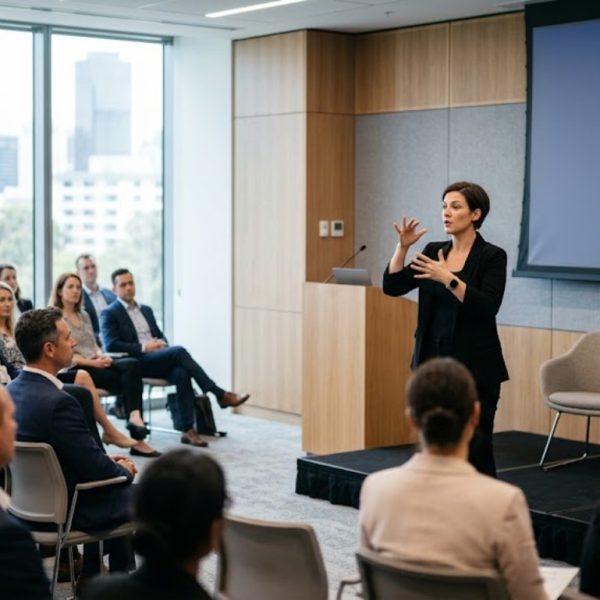
Watch an ASL interpreter work a two-hour conference session and the first thing you notice is that the hands are the smallest part of the job. Eyebrows, mouth shape, shoulder position and the speed of a signed phrase all carry grammar. The interpreter is not converting words. They are rebuilding meaning in a language with its own syntax, its own regional variation and its own literature, in real time, while a speaker three metres away keeps talking.
Deaf people have been telling hearing audiences this for decades, usually without being believed. The persistent myth that signing is a manual version of English is why so many organisations still book the wrong person, or nobody at all, and then wonder why the accommodation failed.
American Sign Language is a language, not a code
American Sign Language has its own grammar, which is closer in structure to some spoken languages than to English. Topic comes first, then comment. Time markers are established at the start of a sentence and then assumed. Spatial reference does work that English handles with pronouns, and facial expression carries what English handles with intonation and punctuation.
It also has dialects, generational shifts and slang, and it is not universal. British Sign Language and ASL are mutually unintelligible, which surprises almost everyone the first time they hear it. Anyone booking interpreting services internationally needs to know that. The historical background of American Sign Language and its French roots explains a lot about why the two systems diverged so completely.
What an ASL interpreter handles in real time
Simultaneous interpreting is cognitively brutal. The interpreter listens, holds meaning in working memory, restructures it into a different grammar and produces it, all while monitoring the next incoming sentence and watching the deaf consumer for signs of confusion. Research on interpreter fatigue is the reason teams of two rotate every fifteen to twenty minutes in long assignments. A single interpreter kept working for ninety minutes will make errors, and in a medical or legal setting those errors have consequences.
There is also the preparation nobody sees. A competent ASL interpreter asks for slides, agendas, name lists and technical vocabulary in advance. Sending them an hour beforehand is not a courtesy, it is the difference between accurate work and improvisation. Clients who withhold materials for confidentiality reasons should ask about non-disclosure agreements rather than simply refusing.
How to become a sign language interpreter
The route is longer than most people expect. Fluency comes first, and fluency means years of immersion in the Deaf community rather than a semester of evening classes. Interpreter preparation programmes at associate or bachelor level then teach the mechanics of the transfer process, ethics, and the very specific discipline of staying out of the conversation you are facilitating.
Certification follows. In the United States, national certification is administered through the Registry of Interpreters for the Deaf, and the guidance published by the National Association of the Deaf is the clearest starting point for anyone weighing the path. Expect written and performance testing, ongoing professional development requirements and specialist credentials for legal work.
The trajectory has a lot in common with spoken-language legal interpreting, where the bar is set by examination rather than by self-declaration. A detailed account of what court interpreter certification involves gives a realistic picture of the testing standard candidates face in both fields.
Becoming an ASL interpreter is a useful example of a career that cannot be entered through a generic pathway, since certification, community trust and practical hours all matter more than a job title. Anyone researching a specialised route quickly discovers how little standard career advice has to say about professions with their own gatekeeping. The more specific the field, the more generic advice tends to fail.
Signed language makes the visual channel non-negotiable in a way spoken language rarely does. It is the clearest illustration of why video remote interpreting exists as a distinct service rather than a nicer version of a phone call. For spoken languages the calculation is more finely balanced, and worth working through deliberately.
Certified deaf interpreters change what is possible
A certified deaf interpreter is a deaf professional who works alongside a hearing ASL interpreter, and their presence transforms outcomes in the hardest assignments. They are the right call when the deaf person uses a foreign sign language, has limited formal language exposure, has a cognitive or linguistic disability, or is a child. In court proceedings and emergency medicine, that team model is often the only arrangement that produces genuinely accurate communication.
Organisations tend to resist because it looks like paying for two people to do one job. It is not. It is paying for the only configuration that works when the linguistic distance is wide.
Booking well, and what usually goes wrong
Give the agency the setting, the subject matter, the duration and the number of deaf participants. Book teams for anything over an hour. Confirm sightlines and lighting before the day, because an interpreter placed behind a lectern or in front of a bright window is functionally invisible. For video calls, pin the interpreter and make sure the platform allows it.
The failures are almost always logistical rather than linguistic. Someone books a single ASL interpreter for a full-day training. Someone seats the interpreter where the deaf attendee cannot see both the slides and the signing. Someone forwards a fifty-page technical deck the night before. None of that is the interpreter's fault, and all of it is preventable.
Sign language interpreting sits inside a much broader professional field, and organisations that already commission spoken-language work will recognise the same standards and the same booking discipline. PoliLingua's overview of how interpretation services actually work covers the shared ground well, including the difference between consecutive and simultaneous modes.
The underlying point is simple enough. Access is not a favour extended to deaf participants, and an interpreter is not a piece of equipment. Book properly, brief properly, and the room works.